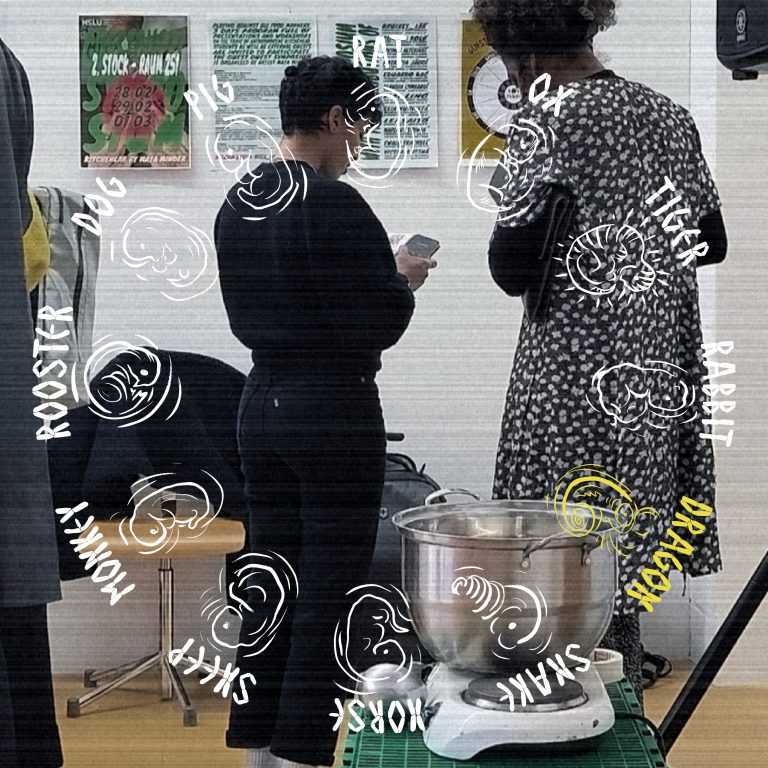
On January 5-9, Shanghai Institute of Visual Arts (SIVA) hosted a distinctive and immersive HOX Zodiac intensive workshop. Invited by the DeTao Masters Academy and jointly organized by the School of Future Design at Shanghai Institute of Visual Arts, internationally renowned media artist and UCLA Design Media Arts professor Victoria Vesna led students in an in-depth dialogue centered on genetic science, zodiac culture, and contemporary art.
The HOX ZODIAC project has evolved over the past 18 years and has previously been exhibited in Los Angeles, New York, Hong Kong, Taiwan, Tsukuba, Vienna, Paris, Motovun, and Slovenia. Rooted in Chinese zodiac culture and coinciding with the transition from one lunar year to the next, this marked the project’s first presentation in mainland China — both a cultural homecoming and a timely, symbolically resonant moment.
A Performative / Participatory Luncheon
The workshop culminated in a performative luncheon that brought together faculty and students from SIVA, alongside invited artists, engineers, and scientists. Seated at a long table according to their zodiac signs, guests became part of a carefully staged interdisciplinary performance. Students presented each dish in sequence, pairing food with concise narratives that linked zodiac symbolism to genetics, ecology, and evolving relationships between humans and animals.
Using the zodiac as a shared language, the event unfolded as a warm yet intellectually charged exchange between art and science. Conversation flowed freely, and ideas collided across disciplines.
In his closing remarks, Lin Min, Executive Vice President of SIVA, praised the students’ work and emphasized the importance of engaging with traditional Chinese culture through contemporary, interdisciplinary approaches. He encouraged students to develop cultural confidence and to contribute new Chinese narratives within a global context. He also highlighted the workshop’s underlying philosophy of non-anthropocentrism, where humans and animals are understood as equal participants in a shared ecological system — an idea with growing relevance for our collective future.
DAY 1: Introduction to the Zodiac
Dressed in white lab coats and holding petri dishes, test tubes, and project manuals, students gathered around a circular table to begin their exploration. Guided by Victoria Vesna, they started by drawing their own zodiac symbols and systematically studied the associated internal organs, Five Elements, dietary therapy, constellations, mythical creatures, Eastern and Western mythologies, and the applications of animals in medicine and science — greatly expanding their perspectives.
The session concluded with a food-sharing segment. As a Pig zodiac, Victoria used the example of a pork jerky to spark reflection on the life cycle of “eating and being eaten,” prompting discussion on human–animal relationships through the lens of the food chain.
DAY 2: Lab Coat Creation
Students painted “embryonic forms” of their zodiac animals onto their lab coats, symbolizing the origins of life. Green echoed the concluding Year of the Wood Snake, while red welcomed the forthcoming Year of the Fire Horse, creating a visual transmission of energy.
At lunchtime, participants sat together for their first shared meal and storytelling session. From cultural symbolism to personal memories, each snack transformed from mere food into a vivid cultural fragment. The table was filled with relaxed, joyful conversation, where knowledge and emotion flowed naturally through dialogue.
DAY 3: Menu Design
Building on the previous two days of research, students worked in groups to design menus around the theme “Eat or Be Eaten.” They rehearsed simulated presentations, weaving personal zodiac stories and knowledge into their narratives to enrich cultural depth and individual expression.
At the same time, teams developed audiovisual works inspired by the twelve zodiac animals — editing videos, processing animal sound materials, and advancing animated visual expressions. Interspersed micro-lectures on HOX genes, biotechnology, and animal ethics helped build bridges for interdisciplinary dialogue between practice and critical reflection.
DAY 4: Scene Construction
Using tablecloths in black, yellow, green, white, and red — corresponding to the Five Elements — the space was transformed into a dining environment that blended ritual and experimentation. Students collaborated efficiently under time constraints, preparing self-designed menus, cultural cards, and hand-painted lab coats as gifts for guests.
HOX gene souvenirs, handwritten name cards, and the completed lab coats were carefully arranged. Meanwhile, menus underwent multiple rounds of refinement, plating designs were continuously optimized, and video and audio elements were repeatedly adjusted to achieve their best form.
DAY 5: Hox Zodiac Luncheon
After completing movement rehearsals and final process checks, the meal preparation itself became an intense exercise in collective collaboration. At noon, guests arrived and joined the performative banquet. Faculty and students raised their glasses together in tribute to a friendship and co-creation that transcended species, culture, discipline, and identity.
Guided by Victoria Vesna, students took turns explaining the cultural systems embodied by each zodiac sign — from organ correspondences and mythological narratives to cosmology, animal behavior anecdotes, dietary therapy, and medical applications. Cuisine, storytelling, table rituals, audiovisual presentations, and a concluding holographic image interwove layer by layer, constructing a multidimensional immersive journey. Together, guests and participants formed a vivid zodiac energy map, creating an atmosphere that was both solemn and lively.
Click to watch the student-produced video
The five-day HOX Zodiac workshop concluded successfully through reflection, creation, and dialogue. With a distinctive experimental spirit, this interdisciplinary practice fused genetic science, zodiac culture, and artistic creation. It offered an innovative reinterpretation of traditional Chinese zodiac culture while serving as a vibrant continuation of Victoria Vesna’s 18-year, globally connected HOX ZODIAC project in mainland China.
Although the workshop has ended, the five days of hands-on practice, intellectual exchange, and deep dialogue provided students with an unforgettable professional experience. The cross-cultural perspectives and creative inspirations initiated here will continue to resonate in their future studies and thinking, opening up new possibilities and ideas.
Honored Guests (by Zodiac cycle):
Rat—闫金丽 Yan Jinli; Ox—马麟鸿 Ma Linhong; Tiger—熊洁 Xiong Jie; Dragon—吴俊 Wu Jun, 薛刚 Xue Gang, Soeun Bae; Snake—张弘 Zhang Hong; Horse—陈月浩 Chen Yuehao, 刘玉婷 Liu Yuting; Sheep—金豪 Jin Hao, 陈迪辉 Chen Dihui; Monkey—张恒 Zhang Heng; Rooster—林敏 Lin Min; Dog—木巾 Mujin.
工作坊组织 (Workshop Coordinator):
Dragon—李天娇 (Li Tianjiao)
摄影 (Photographer):
Pig—赵奕瑶 (Zhao Yiyao)
翻译(Translator)
Dragon—张婷婷 (Zhang Tingting)
特别致谢 (Special Thanks):
Rat—闫金丽 (Yan Jinli)
Students: Mouse—丁奕程 Ding Yicheng; Dog—查恒烨 Cha Hengye, 丁予宁 Ding Yuning, 刘一涵 Liu Yihan; Monkey—陈定鸿 Chen Dinghong; Rooster—刘慕瑶 Liu Muyao; Pig—郝婕 Hao Jie, 刘宇琦 Liu Yuqi, 马千画 Ma Qianhua, 沈乐然 Shen Leran, 汪欣月 Wang Xinyue.